

Patient-centered, physician-partner, employee-based
Wuhan Aier Eye Hospital Successfully Performs FCB Surgery, Providing a New Treatment Approach for Retinal Detachment Patients
Release time: Jul 26,2024
Wuhan Aier Eye Hospital Successfully Performs FCB Surgery, Providing a New Treatment Approach for Retinal Detachment Patients
Wuhan Aier Eye Hospital has successfully performed the first Foldable Capsular Buckle (FCB) implantation surgery in the hospital. The team led by Professor Wu Jianhua carried out a cutting-edge technology for treating retinal detachment - FCB implantation - on a patient with rhegmatogenous retinal detachment. The FCB implantation does not alter the intraocular environment, significantly shortens the surgery time, allows patients to adopt a free lying position after surgery, and improves the surgical experience. The implementation of this technology adds a new wing to the hospital's treatment of difficult fundus diseases, marking a new step forward in its diagnostic and treatment capabilities!
Medical Condition Overview
Two months ago, the patient developed a sensation of visual obstruction in the left eye without obvious cause, accompanied by decreased vision, and then consciously felt the symptoms gradually worsening, affecting life. Therefore, he came to Wuhan Aier Eye Hospital for treatment, and the outpatient department admitted him with "left eye rhegmatogenous retinal detachment".
Professor Li Xiangyun examined him and found that the naked eye vision of the left eye was 0.06; the intraocular pressure of the left eye was NCT10mmHg. The retina in the inferotemporal part of the left eye was grayish white and raised, involving the macula, and a horseshoe hole about 1PD in size was seen in the peripheral part at the 3 o'clock position.
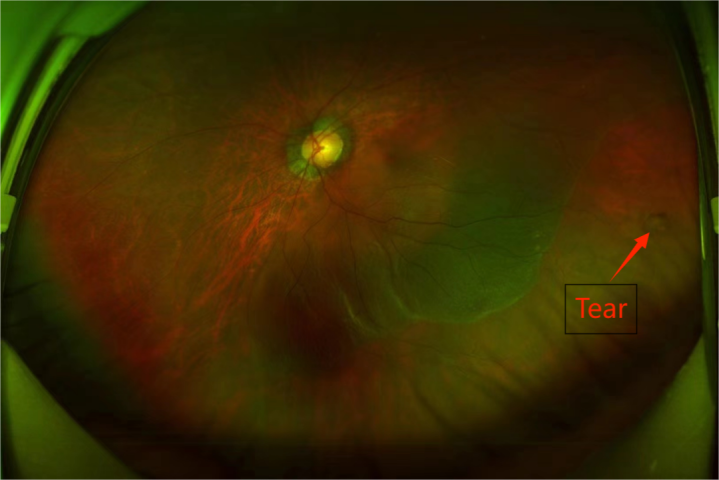
Considering the patient's single tear in the left eye and good retinal mobility, Professor Wu Jianhua formulated a suitable treatment plan in combination with the medical condition and the patient's wishes. After full communication with the patient, the latest ultra-minimally invasive retinal reattachment surgery - Foldable Capsular Buckle (FCB) implantation - could be performed for him.

The team of Professor Wu performed left eye episcleral buckling + Foldable Capsular Buckle (FCB) implantation for the patient. On the second day after surgery, laser photocoagulation was given to the retinal tear in the left eye after retinal reattachment. On the third day after surgery, the patient recovered well and was discharged. The left eye vision at discharge was 0.06, corrected to 0.2, the retina was flat, a pressure ridge was visible in the temporal peripheral retina, the hole was on the ridge, laser spots and cryotherapy spots were visible around the hole, and the macular foveal reflex was not seen. The patient was satisfied with the postoperative effect and expressed heartfelt gratitude to Professor Wu and Professor Li!

Ultra-Minimally Invasive Treatment of Rhegmatogenous Retinal Detachment
Traditional retinal detachment repair surgery is divided into two surgical approaches: internal and external. More doctors recommend the external approach, which can ensure that the oxygen balance of the eyeball itself is not destroyed.
External Approach Surgery vs. Internal Approach Surgery
- Internal approach surgery (vitrectomy): It has large damage, is irreversible, has a slow recovery, is expensive, requires the patient to rest in a prone position for two to three weeks after surgery, and if silicone oil is filled, another surgery is needed to remove it after one to three months.
- Traditional external approach surgery (scleral buckling): It has relatively large damage and a low success rate. Once successful, no repeated surgery is needed.
Foldable Capsular Buckle (FCB) vs. Traditional External Approach Surgery
FCB implantation belongs to one of the external approach surgeries. Compared with the traditional retinal external approach surgery, FCB has the advantages of shortened surgery time (from 50 minutes to 10 minutes), no retrobulbar anesthesia, no muscle traction, no scleral fluid release, no intraoperative positioning, and no cryotherapy for the tear. Doctors only need to implant the folded balloon into the outer wall of the eyeball at the detachment site, and then inject normal saline to make the balloon swell, which "props up" the detached retina like a jack. It has a fast recovery after surgery, greatly reduces the patient's pain, avoids many postoperative complications, and can greatly enhance the treatment experience of "retinal detachment" patients. It is worth mentioning that this surgery also adopted a 3D reconstruction calculation method to accurately judge the position of the tear, which can effectively improve the correctness and reattachment rate of tear reattachment.

Doctor Profiles
Wu Jianhua, Professor

Chief Physician
Chief Physician, Associate Professor, Master's Supervisor, Master, Visiting Scholar at Doheny Eye Institute
Academic Appointments: Deputy Director of the Medical Quality Creation Working Committee of the China Pharmaceutical Quality Association, Deputy Director of the Third Committee of the Ophthalmologist Branch of the Hubei Medical Doctor Association, Deputy Leader of the Ocular Trauma and Oculoplastic Group of the Ophthalmology Branch of the Hubei Medical Association, Standing Member of the 16th Ophthalmology Branch of the Wuhan Medical Association, Deputy Leader of the Fundus Disease Group of Aier Eye Hospital Group.
Position: Deputy Dean of Hubei Province of Aier Eye Hospital Group, Dean of Wuhan University Affiliated Aier Eye Hospital.
Introduction: Specializes in the diagnosis and treatment of various fundus diseases, especially difficult eye diseases, and is particularly expert in the diagnosis and surgical treatment of retinal detachment, retinal angiomatosis, retinal vasculitis, diabetic retinopathy, age-related macular degeneration, and vitreous diseases. He has rich experience in using 23/25/27G minimally invasive vitrectomy for the treatment of acute submacular hemorrhage, autologous retinal neuroepithelial transplantation for refractory macular holes, refractory complex PVR/APVR, and complex ocular trauma. He went to Doheny Eye Institute in Los Angeles, USA as a visiting scholar for further study in 2012. He has published many academic papers and served as the deputy editor of two ophthalmic academic monographs, Clinical Ophthalmic Surgery and Clinical Ophthalmic Diagnosis and Treatment Routine. The Academic Committee of Aier Eye Hospital Group awarded him the honorary title of "Vitrectomy Master".
Li Xiangyun, Professor

Associate Chief Physician
Associate Chief Physician, Deputy Director of the Fundus Disease Department, Secretary and Member of the Fundus Disease Group of Hubei Province of Aier Eye Hospital Group.
Mainly engaged in minimally invasive surgery for the treatment of various fundus diseases. Many papers have been published in SCI journals and core academic journals, and participated in compiling the book Clinical Ophthalmic Surgery.
Wuhan University Affiliated Aier Eye Hospital

Wuhan University Affiliated Aier Eye Hospital is a large-scale tertiary specialized eye hospital established in 2003 with the approval of the Hubei Provincial Health Commission, integrating medical treatment, teaching, scientific research, myopia prevention and control, and blindness prevention and treatment. The hospital has been successively recognized as a National Drug Clinical Trial Institution, a standardized training base for resident physicians in ophthalmology; in 2016, it was recognized as a Key Clinical Specialty (Ophthalmology) of Tertiary Hospitals in Hubei Province and a Key Clinical Specialty (Ophthalmology) at the Wuhan municipal level; it has won the "May 1st Labor Award" in Wuhan and other honorary titles. In the 2019 Chinese Hospital Science and Technology Value Ophthalmology ranking, it ranked 50th in the country.
The hospital has a headquarters (Wuchang Campus), Hankou Campus, Hanyang Campus, Hongshan Campus, Huangpi Campus, Qingshan Campus, Wuhan University Aier Eye Clinical College, Wuhan University Aier Eye Research Institute, Wuhan Aier Eye Research Institute, Wuhan Aier Eye Bank, and multiple outpatient departments. It has 584 beds. There are currently 786 medical and health personnel, including 35 chief physicians, 80 associate chief physicians, and 143 attending physicians. There are 73 optometrists in total, including 15 national first-class (senior) optometrists and 17 national second-class optometrists. There are 31 master and doctoral supervisors, 52 doctors, 176 masters, and a total of 29 experts hold academic positions in national, provincial, and municipal ophthalmic academic organizations. A total of 15 doctors have been elected as key medical talents in Wuhan.
The hospital has 12 departments, including the Refractive Department, Ocular Surface and Corneal Disease Department, Glaucoma Department, Cataract and Presbyopia Department, Fundus Disease Department, Strabismus and Pediatric Ophthalmology Department, Lacrimal Passage/Eye-Nose Related Department, Eyelid Orbit Disease/Oculoplastic Cosmetology Department, Comprehensive Eye Disease Department, Optometry Department, Anesthesiology Department, and Functional Imaging Department. It has 30 ophthalmic special disease clinics, such as dry eye clinic, high myopia clinic, floaters clinic, macular disease clinic, diabetic eye disease clinic, difficult lacrimal passage disease clinic, ptosis and repair clinic, myopia prevention and control clinic, and refractory glaucoma clinic. The hospital also has a famous doctor special needs clinic, where nationally renowned ophthalmology experts regularly sit for consultations to provide diagnosis and treatment plans for patients with difficult eye diseases.
In the past ten years, the hospital has undertaken 2 projects of the Hubei Provincial Department of Science and Technology, 15 projects of the Hunan Provincial Department of Science and Technology, 12 projects of the Hubei Provincial Health Commission, and 58 projects of the Wuhan Municipal Health Commission. It has produced 96 scientific research achievement patents, 13 software copyrights, and more than 343 scientific papers (including more than 67 SCI journal papers). In 2008, as the editor-in-chief unit, it founded the medical journal Ophthalmic Practice and Research, which has been published for 45 issues so far; it has compiled and published 13 medical monographs. It has hosted 10 national medical continuing education projects, 20 provincial continuing education projects, and 8 municipal continuing education projects.
The hospital is committed to introducing international cutting-edge ophthalmic technologies, adopting modern management concepts and medical management concepts, adhering to the development path of specialization, standardization, and intelligence, and promoting the high-quality development of ophthalmic medical undertakings in Hubei Province and even the whole country.
As a pioneer in FCVB surgery since 2021, Sichuan Provincial People’s Hospital has performed this procedure for nearly 20 patients suffering from ocular trauma and silicone oil dependency to safeguard their ocular health with professional expertise. It represents the inheritance and upgrading of the hospital’s diagnostic and treatment technologies, as well as its commitment to delivering high-quality, precise medical services for patients with complex eye diseases.
04/16
Compared to conventional surgery, FCB implantation offers significant advantages. The procedure requires only a 4mm conjunctival incision, causes minimal tissue damage, and results in less postoperative pain and faster recovery.
04/12

R&D Center
Media
Cases
Search for product information you are interested in
CONTACT US
+8618960050093
Building11,No.6,Nanjiang 2nd Road, Zhujiang Street, Nansha District,Guangzhou


©COPYRIGHT 2024 Guangzhou Vesber Biotechnology Co., Ltd. | SEO Tags Privacy Policy